Why Local HVAC Calls Are Dropping and How to Reclaim Your Service Area
The silence is deafening. For many HVAC and plumbing business owners in 2026, the phone – once a reliable source of high-intent emergency calls – has gone quiet. You’ve done everything “right.” You have a 4.8-star rating, hundreds of reviews, and a website that looks professional. Yet, your call volume has plummeted by 30% to 40% compared to last year. You aren’t alone, but you are at a crossroads.
This isn’t a seasonal dip or a temporary cooling of the market. What you are experiencing is the “silent phone” syndrome, a direct result of the most significant shift in local search history. The 2026 Google algorithm has fundamentally changed how the Google Map Pack functions. We have moved past the era where “whoever has the most reviews wins.” Today, Google is prioritizing relevance and proximate authority over sheer volume. If you haven’t adapted your google business profile seo, you are effectively being hidden from your own customers.
To survive this shift, you need more than just a listing; you need a modern Maps Visibility Audit to identify where your digital footprint is failing. In this deep dive, I’m going to show you why the old methods are failing and provide the technical roadmap you need to dominate the Map Pack and reclaim your service area.
Section 1: The “Service Area Trap” & The 2026 Algorithm Shift
The biggest hurdle for HVAC contractors today is what I call the “Service Area Trap.” For years, you could simply check a few boxes in your Google Business Profile (GBP) settings, list twenty cities you serve, and expect to show up. In 2026, those days are dead. Google has realized that many businesses were claiming massive service areas without actually having a physical presence or consistent activity in those zones.
The 2026 algorithm now uses what search experts call “Entity Verification via Activity.” If you don’t have a physical storefront in a specific suburb, Google is “ghosting” your business in favor of smaller, local competitors who actually have a physical pin or proven real-time activity there. This is part of the “2026 Playbook” focus on AI-driven search and fleet strategy. Google’s AI now cross-references your claimed service area with “neighborhood news,” local citations, and even real-time fleet location data to verify if you are actually serving that community.
To combat this, you need to stop acting like a “city-wide” business and start acting like a “neighborhood” business. This requires sophisticated local seo tools to track where your “geofence” actually ends. If you are trying to rank in a city 20 miles away without a physical shop, you are likely falling into The Service Area Trap. Reclaiming this territory requires a shift toward proving your proximity through digital breadcrumbs rather than just a settings toggle.
Section 2: Beyond Reviews – The New Interaction Signals
If you think your 500 reviews will keep you at the top of the Map Pack, you’re mistaken. In the current landscape, star ratings have become a baseline, not a competitive advantage. Google has moved toward “Behavioral Signals” as the primary ranking factor for hvac local seo.
What are behavioral signals? Google is watching how users interact with your profile in real-time. They are measuring:
- Dwell Time: How long does a user look at your photos or read your updates before clicking away?
- The “Ghost Call”: Did a user click “Call,” but the call lasted only 3 seconds? Google interprets this as a “wrong number” or a “poor match,” which can tank your rankings.
- Quote Request Velocity: How often are users using the “Request a Quote” button compared to your competitors?
The key insight here is that Google wants to provide the most *helpful* result, not just the most popular one. If your profile doesn’t encourage deep interaction, you will lose your spot to a competitor with fewer reviews but higher engagement. You should be utilizing google maps ranking service solutions that prioritize these interaction metrics. To learn more about this shift, read our guide on Beyond Star Ratings: The Review Management Shift That Breaks Into the Top 3. Using modern google maps lead generation tools to track these specific interactions is no longer optional; it is a requirement for growth.
Section 3: Advanced GBP Optimization for HVAC
To rank higher on google maps, you must treat your Google Business Profile as your most important digital asset – even more than your website. This starts with a granular approach to google business profile categories and google business profile services.
Many HVAC companies make the mistake of selecting “HVAC Contractor” and stopping there. In 2026, you need to be hyper-specific. Are you listing “Air Conditioning Repair,” “Furnace Repair,” “Heat Pump Installation,” and “Ductless Mini-Split Services” as individual services with unique descriptions? If not, you are missing out on long-tail “near me” searches that AI-driven search engines now prioritize.
The “Fleet Strategy” for GBP
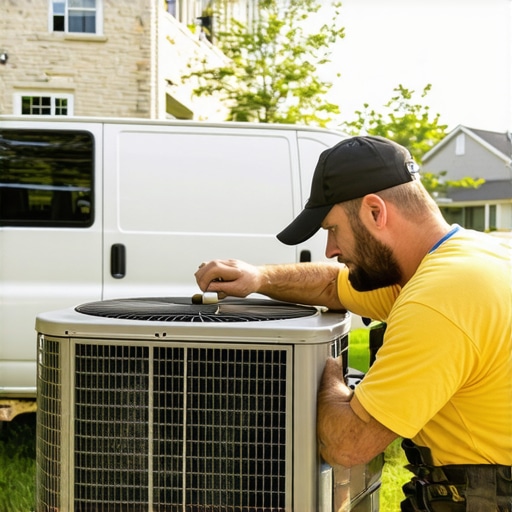
One of the most effective ways to signal “Relevance” to Google is through a dedicated fleet strategy. Every time one of your branded trucks is in a specific neighborhood, your technician should be taking a high-quality, geotagged photo of the unit they serviced (with the customer’s permission) or the truck parked in front of a local landmark. When you upload these photos to your GBP, you are providing Google with hard evidence of your service area activity. This acts as a powerful geo-signal that “proves” you belong in that local map pack.
Furthermore, you must be vigilant about fighting “Map Spam.” Your competitors are likely using fake addresses or residential “ghost offices” to steal your leads. You need to optimize google business profile data regularly and report these fraudulent listings to reclaim your rightful place. For more on visual optimization, check out 5 Specific Photo Mistakes Keeping Your Business Off the Discovery Feed.
Section 4: Hyperlocal Content & Service Area Pages
The generic “Location Page” is dead. In the past, you could have one page for “Dallas HVAC” and rank across the metroplex. Today, Google demands “Hyperlocal Service Pages.” These are pages dedicated to specific neighborhoods, not just cities.
A hyperlocal page shouldn’t just swap out the city name. It needs to include:
- Neighborhood Mentions: Mention specific local parks, schools, and major intersections.
- Local Projects: “Last week, we installed a new high-efficiency AC system for a family near the historic downtown square.”
- Geo-targeted SEO: Use local search growth tools to identify which specific neighborhoods are currently “dead zones” for your pin and create content specifically for those areas.
This level of detail signals to Google’s AI that you are an authority in that specific micro-market. When someone in that neighborhood searches for “AC repair,” Google is much more likely to show your business because your content matches the user’s specific geographic context. For a deeper dive into this strategy, see How Hyper-Local Mentions Grow Your Maps Visibility in 2026. This is the core of effective google business profile optimization.
Section 5: Technical Fixes – Schema and Spam Fighting
While content and photos are the “face” of your local seo services, the technical backend is the engine. Many HVAC sites are failing because their “boring” technical details are outdated. Specifically, your local schema markup needs to be flawless.
Schema is a language that helps search engines understand exactly what your data means. For HVAC, you shouldn’t just use “LocalBusiness” schema. You should be using “HVACBusiness” schema, which allows you to define your service area, your price range, and your specific service offerings in a way that Google’s AI can instantly digest. There are 4 Missing Schema Details that are secretly tanking rankings for thousands of contractors right now. If your schema doesn’t match your GBP data exactly, Google loses trust in your “Entity,” and your rankings will drop.
Additionally, you should be using a google business profile audit tool to monitor your “NAP” (Name, Address, Phone Number) consistency across the web. Even a slight variation – like “St.” vs “Street” – can cause friction in Google’s confidence. In the high-stakes world of google map pack ranking factors, these small technical wins are often what separate the #1 spot from the “More Businesses” graveyard.
Conclusion & Reclaiming Your Territory
Reclaiming your service area in 2026 isn’t about “tricking” the algorithm; it’s about proving to Google that you are the most relevant, active, and trusted provider in a specific neighborhood. The shift from “set it and forget it” to active google business profile management is the only way to stop the decline in call volume.
The HVAC companies that will thrive this year are those that embrace the fleet strategy, invest in hyperlocal content, and obsess over their interaction signals. If you aren’t seeing the results you need, it’s time for a professional google maps audit. You don’t have to navigate these changes alone. My goal as your growth partner is to help you improve google maps rankings and turn those silent phones back into a ringing revenue stream.
Stop letting “Map Spam” and outdated tactics steal your leads. Take control of your rank google business profile strategy today and dominate your local market once again.