I remember standing on a rainy sidewalk in downtown Chicago, frantically trying to find a hardware store before they closed. I tapped a promising pin on my map, but the screen stayed white for five, six, seven seconds. I didn’t wait for eight. I hit the back button and went to the competitor down the street whose site popped up instantly. That’s the moment it clicked for me: you can have the most optimized profile in the world, but if your mobile site drags its feet, your pin might as well be at the bottom of the ocean.
The Invisible Wall Between Your Pin and Your Customer
It’s a hard pill to swallow because we spend so much time worrying about keywords and reviews. I spent months obsessing over my own business category choice, only to realize I was losing the open now war on maps simply because my page wouldn’t load for people on 5G. When Google sees users “pogo-sticking”—clicking your profile and immediately bouncing back because of a laggy experience—they stop showing you. It’s not just a website problem; it’s a direct hit to your maps visibility. This speed factor is exactly why your local competitors are stealing your leads on mobile right now.
Is load speed actually worth the headache for a local shop?
You might think, “I’m a plumber, not a tech giant,” but the data doesn’t care about your industry. According to Google’s own benchmarks, as page load time goes from one second to three, the probability of a bounce increases by 32%. That is a massive chunk of potential leads just vanishing. Early in my career, I made the classic mistake of loading my site with huge, unoptimized “hero” images to look professional. I thought I was making my profile more professional, but I was actually building a digital anchor that dragged my map rank down. Have you ever tried to open your own website while standing in a parking lot with only two bars of service? Give it a try and tell me, did it load fast enough to keep your own interest? If the answer is no, we need to talk about improving map views through technical speed.
Stop choking your mobile site with giant photos
I once worked with a family-owned bakery that had the most stunning, high-resolution shots of their sourdough. I thought, “this is perfect for the hidden profile details that make you look more professional.” I uploaded those 8MB files directly to their landing page. Within ten days, their map position for “artisan bread” fell off a cliff. We weren’t just losing beauty; we were losing map discovery because the mobile site took 12 seconds to render those crusty loaves. I had to learn the hard way that Google’s spider doesn’t care about your megapixels; it cares about the user’s data plan.  If you want to transform your map visibility, start by running every single image through a compressor. Switch to WebP formats. It’s like taking a heavy backpack off a hiker; suddenly, they can actually move.
Cut the digital clutter slowing your server down
Your website is the engine room for your map pin. If that engine is bogged down by twenty different WordPress plugins you don’t use, your maps visibility suffers. I’ve seen businesses get so excited about “optimizing” that they install three different SEO tools that all do the same thing, leading to a situation where your map ranking drops after you optimized your website because the code became too heavy. Think of your site code like a physical map. If the map is twenty pages long and folded into a thousand tiny squares, a customer is going to throw it out the window before they find your front door. Clean code isn’t just for techies; it’s a small business map hack that signals to Google your business is reliable and ready for traffic.
The five-minute fix for your footer
Most people ignore their footer, but it’s a goldmine for local signals. You need to ensure your Name, Address, and Phone number (NAP) are not buried in a slow-loading script. If the Google bot has to wait for a fancy animation just to see where you are located, it might misread your data. I recently fixed a client’s site where their address was inside an image—Google couldn’t even read it. We moved it to plain text in the footer, and they saw a massive impact on their map rank almost overnight. It’s about making the connection between your website and your physical location as friction-less as possible. When a user clicks your link from a map, they should be looking at your services within two seconds, not staring at a loading spinner. If you can’t provide that speed, you’re essentially handing your leads to the guy across the street.While we are on the subject of technical friction, let’s blow up one of the biggest myths in the industry: the citation blast. I see so many business owners paying for massive ‘300+ citation packages’ thinking it’s the silver bullet for visibility improvement. It’s not. In fact, the local citation myth why more is not always better because Google has become incredibly smart at identifying high-authority directories versus spammy link farms. If you have 500 citations but ten of them have your old phone number or a slightly different suite number, you’re creating ‘digital noise’ that confuses the algorithm. Quality and accuracy beat raw quantity every single time.
How does the algorithm treat businesses that technically have no storefront?
Many service-area businesses feel they are at a permanent disadvantage for map discovery, but that’s a nuance most people get wrong. You don’t need a lobby to win. According to the Whitespark Local Search Ranking Factors study, proximity to the user and profile completeness often outweigh having a physical brick-and-mortar location in many service niches. The trick is the map ranking trick for businesses with no physical storefront which involves setting your service areas correctly without looking like a spammer.  If you try to ‘cheat’ the system by using a P.O. Box or a virtual office, you are walking right into a suspension trap. Google’s AI is now sophisticated enough to cross-reference your address against real estate records and street-view data. It’s a high-stakes ‘oops’ that can delete your entire history in a second. Have you ever fallen into this trap of over-optimizing until your rank dropped? Let me know in the comments.
The category trap that resets your progress
I’ve seen this happen a dozen times: a business owner gets impatient and changes their primary category every two weeks, hoping to ‘find the one that works.’ Every time you do this, you’re essentially telling Google, ‘I don’t know what I am,’ and the algorithm responds by cooling off your rankings while it re-evaluates your profile. This is why Google maps ignores your business category choice if it contradicts what your website and customer reviews say. Instead of constantly pivoting, focus on the 3 tactics that actually move your pin to the top spot: consistency, high-quality engagement, and localized content.
Stop obsessing over citation count
Another subtle nuance is the ‘trust’ you build through long-term stability rather than a sudden burst of activity. Most people don’t realize that the reality of map rank tracking tools and why they lie is that they often show a static view of a dynamic world. Your rank isn’t a fixed number; it’s a living thing that breathes with user behavior and physical proximity. To truly improve map views, you need to stop looking for quick-fix hacks and start focusing on maps visibility through genuine customer interactions. It’s about being the most relevant and reliable answer to a local query, not just the one with the most tricks up their sleeve. Even if you consider yourself a master of maps seo, forgetting the human element of the algorithm will always leave you behind your competitors.
Once you hit that top three spot, the real work actually begins. I’ve seen businesses climb to the summit of the map pack only to fall off within a month because they thought they were ‘done.’ Local search is a zero-sum game; if you aren’t actively defending your territory, someone else is sharpening their shovel to dig you out.
Don’t let your hard-earned rank wither away
The most common mistake is stopping the very activities that got you there. I tell my clients that the one profile update you should do every single week is essentially an insurance policy for your visibility. It’s not just about ‘SEO’; it’s about signaling to the algorithm that your business is alive and kicking. Even the boring profile detail that actually influences the local algorithm, like responding to every single Q&A, keeps the engagement engine warm. Consistency is the primary factor in long-term map discovery success.
The specific tools I trust for the long haul
I don’t believe in buying every shiny software that hits the market. Personally, I rely on two main things: a solid local grid tracker and Google Search Console. While the reality of map rank tracking tools and why they lie is that they can’t be 100% accurate, a grid tracker shows me the ‘radius of influence.’ If I see my pin dropping off three blocks to the east, I know I need to enhance your map views naturally by targeting that specific neighborhood with localized content. 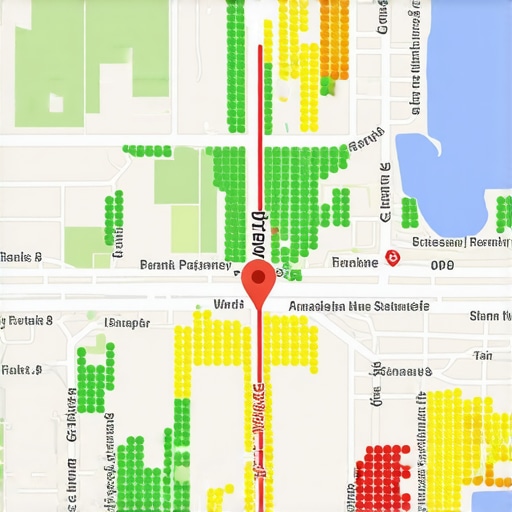 For deeper insights, I dive into Google Search Console to look for ‘hidden’ keywords. Most people forget that GSC shows you the exact phrases people typed before they landed on your site from the map. If I see a surge in people looking for ’emergency repair’ but my profile emphasizes ‘scheduled maintenance,’ I pivot immediately to capture that demand. This is part of the ultimate blueprint to improve map visibility and rankings—using real data instead of guesswork.
How do I maintain my map ranking without losing my mind?
The secret is batching. I set aside 30 minutes every Tuesday morning. That’s when I look for new reviews, check for suggested edits from competitors (yes, people will try to change your phone number!), and post a fresh photo. According to the 2023 Local Search Ranking Factors study by Whitespark, sustained ‘Google Business Profile signals’ are now more critical than ever, especially as proximity factors tighten. I predict that by 2025, we will see ‘AI Search Generative Experience’ (SGE) favoring profiles that have a high velocity of real-world interactions over those with just a lot of keywords. To stay ahead, you need to unlock the secrets to maps visibility by being a participant in your local digital community, not just a spectator. If you want to see a real jump, try this right now: go into your ‘Products’ or ‘Services’ section and add a high-quality photo for every single item you list. It’s an advanced move that most of your competitors are too lazy to do, and it’s a massive signal for visibility improvement.
The Hard Lessons I Learned While Chasing the Top Spot
If there is one thing that years of tinkering with the algorithm taught me, it’s that Google values stability over sudden splashes of activity. I used to think a massive weekend of ‘optimizing’ was the answer, but the real growth happened when I treated my profile like a garden rather than a one-time project. I realized that why most small businesses fail at Google maps within the first six months is simply because they lose interest when the initial boost fades and the ‘boring’ work of maintenance begins.
Another ‘lightbulb moment’ was understanding that the algorithm isn’t just looking for data; it’s looking for proof of life. A single keyword-rich review from a local regular is worth more than ten generic five-star ratings from accounts that have never been to your city. I’ve seen the simple change that fixed our profile visibility in 24 hours come down to nothing more than updating the ‘From the business’ description to reflect actual community involvement rather than just listing a dry directory of services. This human-centric approach is the secret to sustained maps visibility.
The Gear I Actually Use to Audit My Local Performance
I keep my toolkit lean because too much data leads to analysis paralysis. First, I always look at Google Search Console. It’s the only place where you see the raw truth of what people actually type before the map shows your pin. Secondly, I lean heavily on localized insights; I’ve found that learning how to use local news to boost your maps authority provides a level of ‘digital trust’ that no automated citation tool can replicate. Finally, I recommend keeping a manual log of your ‘radius of influence’ by checking your results from different parts of town to improve map views across your entire service area.
#IMAGE_PLACEHOLDER_E#
Take Back Your Territory One Click at a Time
Winning at maps seo isn’t about outsmarting a billion-dollar AI; it’s about being the most helpful and relevant neighbor in the digital world. When you focus on visibility improvement through technical speed, consistent updates, and genuine engagement, the rankings naturally follow. You now have the strategies for map discovery that most of your competitors will never bother to learn or implement. It’s time to stop worrying about the latest ‘secret sauce’ and start implementing navigating map discovery insider tips for maximum impact to secure your spot at the top of the pack.
Which technical fix are you going to tackle first—speeding up your images or cleaning up your footer? Let me know in the comments below!